Keeping underrepresented songbirds on the CITES agenda
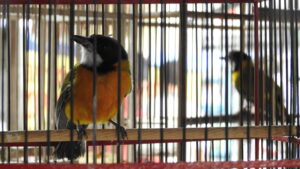
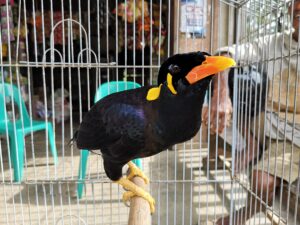
Despite being heavily traded both domestically and internationally around the globe, songbirds (Passeriformes) remain significantly underrepresented* in CITES listings, leaving many traded species without adequate international protection.
At CoP19 Parties adopted CITES Decisions 18.256 to 18.259 calling for:
- A preliminary study on the scale and scope of international songbird trade.
- Consultation with technical experts.
- A dedicated technical workshop to review findings and recommend next steps.
This workshop was held in Bangkok in 2023 and confirmed a major gap: songbirds are traded in high volumes yet poorly represented in CITES, even among species facing serious conservation risk. The workshop recommended further CITES action, including support for possible listing proposals.
However, most recommendations remain unaddressed, and based on these still-preliminary efforts, the CITES Animals Committee is now proposing to delete these Decisions (proposal CoP20 Doc. 83) without completing their required actions.
Update: Brazil submitted an Information Document (CoP20 Inf. 52) calling for ongoing decisions in support for songbirds. During the discussions it was decided to form a drafting group for a decision text. This led to the following drafting decision in support of songbirds (CoP20 Com. I. 2) where Columbia, New Zealand, EU and Brazil propose a strong support for songbirds.
At the same time, only one songbird listing proposal (Cop20 Prop. 18)** has been submitted to CoP20.
Our Call to Action:
We urge CITES Parties to:
- Maintain and act on Decisions 18.256–18.259 instead of deleting them prematurely
- Support and encourage research on songbird trade
- Support the current listing proposal from Brazil for the Great-billed Seed-finch (Sporophila maximiliani) in Appendix I.
- List the following look-alike species in Appendix II: Chestnut-bellied (S. angolensis), Black-billed (S. atrirostris), Large-billed (S. crassirostris), Thick-billed (S. funerea), and Nicaraguan (S. nuttingi) Seed-finches.
- Support future CITES listings for eligible songbird species including Appendix III listings for nationally protected species which regularly appear in the international trade.
Protecting songbirds can’t wait. Their global trade is real — and CITES must reflect it.
Recent supportive research:
Donald, P.F. et al. (2023) ‘Assessing the global prevalence of wild birds in trade’. bioRxiv, p. 2023.08.09.552606. Available at: https://doi.org/10.1101/2023.08.09.552606.
Juergens, J. et al. (2021) ‘A standardized dataset for conservation prioritization of songbirds to support CITES’, Data in Brief, 36. Available at: https://doi.org/10.1016/j.dib.2021.107093.
Jacqueline Jürgens, Johanna Staerk, Simon Bruslund, Rikke Oegelund Nielsen, Dalia A. Conde,(2025) CITES Appendix III matters: Hidden impacts of CITES deletions on global bird trade, Biological Conservation, Volume 310, 2025, Available at: https://doi.org/10.1016/j.biocon.2025.111365.
Anna Haukka, Jacqueline Jürgens, Johanna Staerk, Aleksi Lehikoinen, Simon Bruslund, Andrea Santangeli, (2025) Aesthetic values predict bird trade, but the association varies across product types and trade regions, Biological Conservation, Volume 313, 2026, Available at: https://doi.org/10.1016/j.biocon.2025.111572.
Chris R. Shepherd, Boyd T.C. Leupen, S. Sunny Nelson, Lalita Gomez, John A. Allcock, Simon Bruslund, Caroline Dingle and Vincent Nijman (2023) Global commercialisation, under-reported trade, and the need for increased international regulation of a non-CITES listed songbird , Journal of Asian Ornithology, Vol. 39, 2023. Available at: 2023SH1.pdf
Sarah Heinrich, Boyd T.C. Leupen, Simon Bruslund, Andrew Owen, Chris R. Shepherd, (2021) A case for better international protection of the Sumatran Laughingthrush (Garrulax bicolor), Global Ecology and Conservation, Volume 25, 2021. Available at: https://doi.org/10.1016/j.gecco.2020.e01414.
* The Songbird Species Knowledge Initiative project identified a high diversity of songbird species in international trade with several being threatened with trade considered a primary driver but that only a tiny fraction of these are protected in CITES annexes. A subsequent litterature review made by BirdLife International Trade in wild birds: a global overview confirmed these findings. Based on these studies and the Bangkok Technical Workshop a preliminary priority list of songbird species was produced.
** During CoP20 a single listing proposal for a songbird species has been submitted for consideration CoP20 Prop. 18. We strongly support this proposal by Brazil for the inclusion of the Great-billed Seed-finch in Annex I as well as inclusion of similar looking Chestnut-bellied Seed-Finch, Black-billed Seed-finch, Large-billed Seed-finch, Thick-billed Seed-finch and Nicaraguan Seed-finch in Annex II.