
Songbirds at CITES CoP20 – our side event

Text by Tomasz Rusek, EAZA Brussels office

On 2 December 2025, EAZA proudly co-hosted a side event at the CITES CoP20 in Samarkand (Uzbekistan), dedicated to the protection of songbirds, again bringing our long-standing Silent Forest work to the global stage.
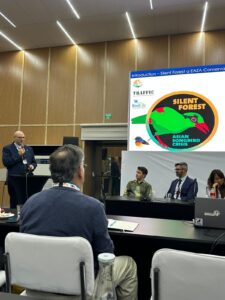
Image by Ida Christine Ladefoged Jacobsen

The event presented case studies from across the world on how international trade is impacting songbird populations, demonstrating that songbird trade issues is a global problem and showing why strengthened measures – within CITES and beyond – are urgently needed.

EAZA speakers Simon Bruslund (EAZA Silent Forest Group, Copenhagen Zoo – Denmark) and Jessica Lee (IUCN SSC Asian Songbird Trade Specialist Group, Mandai Nature – Singapore) shared powerful insights on the trade trends that threaten songbirds and define their conservation needs. They were joined by partners from other conservation NGOs, governments and academia, expressing support for the current proposal for CITES listing of several species of seed-finches in the genus Sporophila.

Image by Ida Christine Ladefoged Jacobsen

“Since the Silent Forest campaign, we have been able to maintain high support for songbirds. EAZA Members have since invested a stunning 2.1 million euros in songbird conservation. This shows the power of our campaigns – in bringing a group of threatened species into focus, and in getting partner organisations aligned for joint action. And while Silent Forest initially focused on Asia, it is clear that the songbird crisis is a global problem and requires global as well as local solutions, from Asia to Europe and Africa to the Americas.” – says Simon Bruslund.

As delegates arrived, they entered a unique bioacoustics show, “The Price of Beauty: Traded Soundscapes” developed by the Creative Conservation Lab. Voices of more than 70 songbird species filled CoP halls – a striking reminder of what is at stake if we fail to act.

Learn more about songbirds at CITES CoP20 here

The Price of Beauty: Traded Soundscapes – listen to songbirds online here
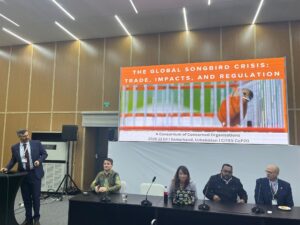
Image by Ilaria Di Silvestre

Click here to access more information on the Side-event including the featured presentations with references.

The side event was co-hosted by CoP20 observer organisations: European Association of Zoos and Aquaria (EAZA), Sustainable Innovation Initiatives, BirdLife International, TRAFFIC, WWF, Monitor Conservation Research Society, Center for Biological Diversity, IFAW, Association of Zoos and Aquariums (AZA), World Association of Zoos and Aquaria (WAZA), Wildlife Conservation Society, Mandai Nature

The event was financially sponsored by: EAZA Silent Forest Group, Copenhagen Zoo, EAZA, WAZA and Lincoln Park Zoo

CITES CoP20 ends on 5 December and the final vote on the listing proposal for the seed-finches is eagerly anticipated.

#CoP20 #CITES #CITESat50 #EAZA #Conservation #EEP #WildlifeTrade #SilentForest #songbirds #passerines
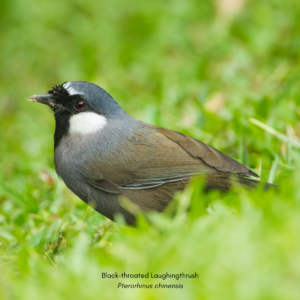
New paper on Black-throated Laughingthrush out: global commercialisation, under-reported trade, and the need for increased international regulation of a non-CITES listed songbird

The Black-throated Laughingthrush Pterorhinus chinensis is one of many songbird species impacted by trade. Found in Cambodia, China, Lao PDR, Myanmar, Thailand and Vietnam, it is sought-after by songbird hobbyists locally and abroad.

The number of songbirds negatively affected by unsustainable trade, especially in Asia, continues to grow. Only a few species are protected where they occur naturally, and fewer still are internationally protected through the Convention on International Trade in Endangered Species of Wild Fauna and Flora (CITES), meaning there is no mechanism to regulate or formally document international trade in that species. This undermines possibilities to protect these songbirds and regulate international trade.

To determine levels of national and international trade, researchers examined Black-throated Laughingthrush trade records extracted from published and unpublished market studies undertaken in parts of Asia and the United States of America (USA). The aim of the study was to establish if listing the Black-throated Laughingthrush in CITES is warranted and further, to identify actions needed to mitigate commercial trade as a threat.

Trade data from the range countries of Thailand and Vietnam as well as from Indonesia and USA, both non-range countries, revealed 10,841 records of Black-throated Laughingthrushes in trade, across 762 visits to 51 markets between 1966 and 2019. The majority (63%) were recorded in locations outside the species’ range. Interesting too was that the highest prices were recorded in the USA and the lowest in Thailand, and that price dynamics in Indonesia indicated high demand and increasing scarcity. The scarcity of the laughingthrushes could be due to rarity in the wild or fewer birds available in the market due to tighter import restrictions – or a combination of both.

At least 4,071 individuals were observed for sale in locations where they are currently protected. The study also found 76 individuals imported into the USA in 2017–2018. While these were recorded as captive bred and having been imported from Senegal for commercial purposes, it is still not clear if this odd case is a transshipment, exports from a captive breeder, or a clerical mistake.

In the European Union (EU), commercial import of the Black-throated Laughingthrush has been restricted since 2005, though imports as ‘personal pets’ are permitted if they come from approved establishments. Despite the restrictions however, it appears as if illegal imports from the wild still occur.

Given the scale of international trade, evidence of illegal imports and the continual decline in wild populations, we recommend that the Black-throated Laughingthrush be included in Appendix II of CITES, to facilitate better documentation and regulation of trade. An Appendix II listing would enable scrutiny of trade dynamics by range countries and to flag any concern on the sustainability of trade as well as limit opportunities for illegal trade through the permitting system.

The authors urge that range countries join forces to propose the CITES listing to protect their native Black-throated Laughingthrush in Appendix at the next Conference of the Parties (CoP20) and request importing countries to support this proposal.

The authors also call on importing countries to use a CITES II listing as a measure to prevent illegal, unsustainable or unregulated imports of Black-throated Laughingthrushes to their territories.

Read the full paper here:

Global commercialisation, under-reported trade, and the need for increased international regulation of a non-CITES listed songbird by Chris R. Shepherd, Boyd T.C. Leupen, S. Sunny Nelson, Lalita Gomez, John A. Allcock, Simon Bruslund, Caroline Dingle and Vincent Nijman was published in the Journal of Asian Ornithology, Vol. 39 (2023).

Read about other laughingthrushes and CITES here: Sumatran Laughingthrush and Chinese Hwamei